
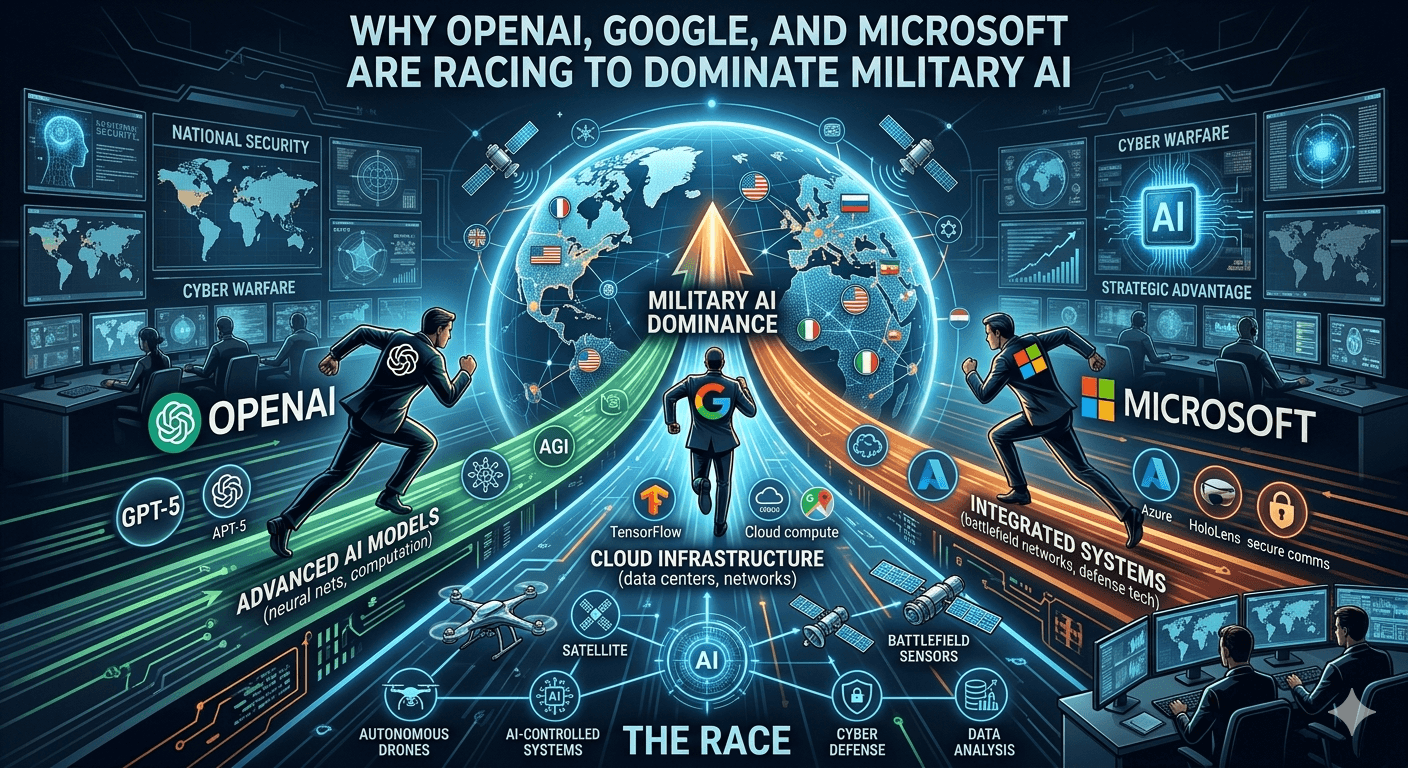
Why OpenAI, Google, and Microsoft Are Racing to Dominate Military AI
Artificial intelligence is rapidly becoming one of the most powerful technologies in modern defense systems. What was once limited to science fiction is now shaping real-world military strategies, cybersecurity operations, surveillance systems, and autonomous technologies. In 2026, major tech companies like OpenAI, Google, and Microsoft are increasingly competing to become leaders in military AI development.
One of the biggest reasons behind this race is national security. Governments around the world understand that AI can provide major advantages in defense operations. AI systems can analyze massive amounts of data in seconds, detect cyber threats faster than humans, improve intelligence gathering, and support decision-making during critical situations. Countries that develop advanced military AI may gain strategic advantages both technologically and economically.
Microsoft has already established strong relationships with government and defense organizations through its cloud infrastructure and cybersecurity services. Its AI-powered systems are being explored for defense logistics, secure communications, and data analysis. The company’s investment in cloud computing also positions it as a critical provider for military-scale AI operations.
Google has also expanded its AI capabilities significantly through advanced machine learning and data processing technologies. While the company previously faced internal debates about military involvement, growing global competition and geopolitical tensions have pushed AI partnerships with governments back into focus.
Meanwhile, OpenAI has become one of the world’s most influential AI organizations thanks to its advanced large language models and generative AI systems. Technologies capable of understanding language, analyzing intelligence reports, and automating complex workflows are increasingly viewed as valuable tools for defense and security sectors.
Another major factor driving this competition is autonomous systems. AI-powered drones, robotics, and surveillance technologies are becoming more advanced every year. These systems can perform tasks faster, reduce risks for human personnel, and operate in environments where traditional systems struggle.
Cybersecurity is also a critical battlefield in the AI era. Governments face constant cyber threats targeting infrastructure, communications, and sensitive information. AI can identify suspicious activity, respond to attacks in real time, and strengthen digital defense systems more efficiently than traditional methods.
However, the rise of military AI also raises ethical concerns. Many experts warn about the risks of autonomous weapons, AI-driven surveillance, and reduced human control in military decisions. The debate around regulation, transparency, and responsible AI use is becoming increasingly important as technology evolves.
Final Thoughts
The race to dominate military AI is not just about technology—it is about global influence, security, and future power. As OpenAI, Google, and Microsoft continue investing heavily in advanced AI systems, the relationship between artificial intelligence and defense will likely shape international politics and security strategies for years to come.