
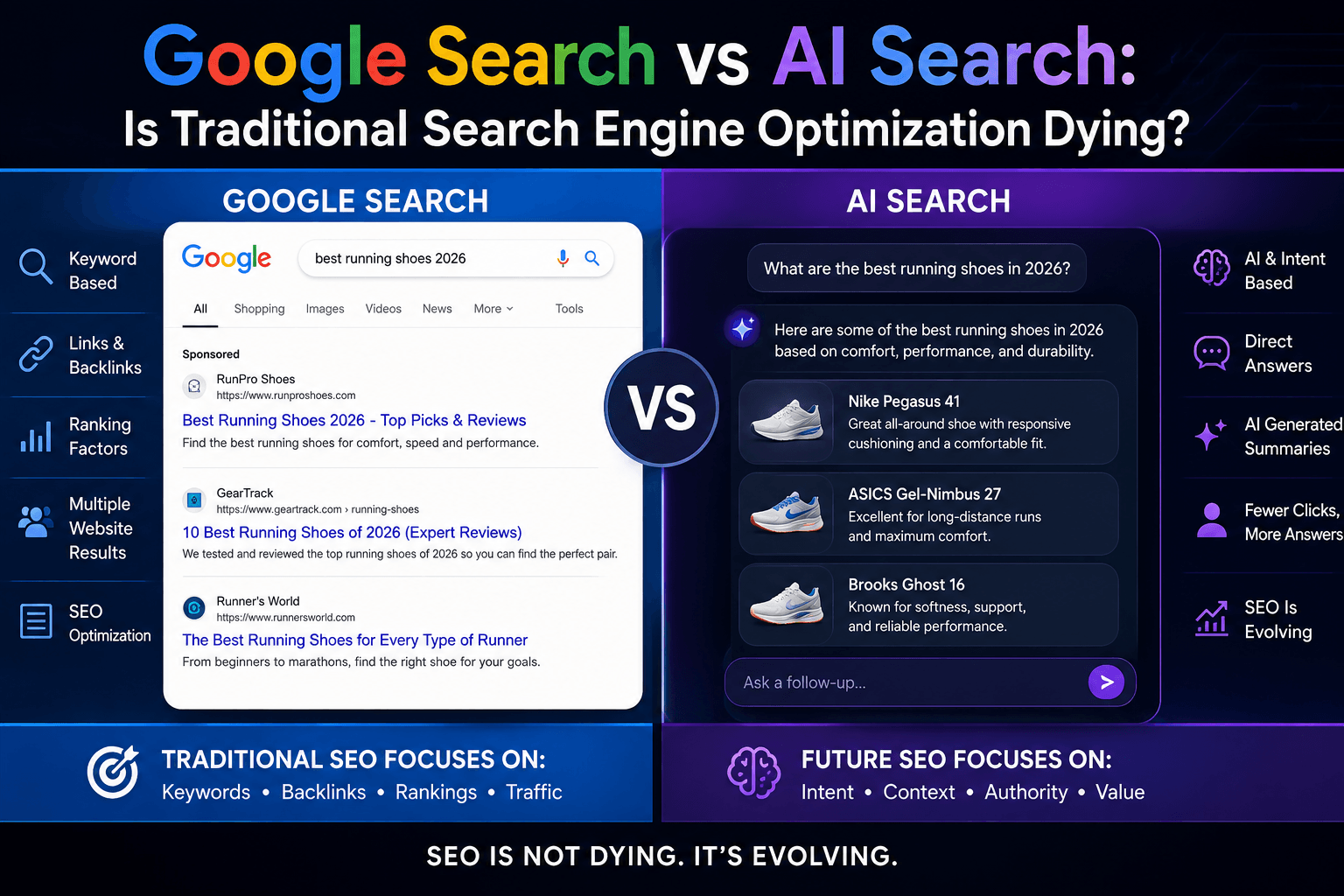
Google Search vs AI Search: Is Traditional Search Engine Optimization Dying?
In 2026, the debate over whether Search Engine Optimization (SEO) is “dying” has reached a fever pitch as AI Search—driven by platforms like OpenAI’s search features, Perplexity, and Google’s own AI Overviews—fundamentally rewrites the rules of digital discovery. While traditional SEO as we knew it (keyword stuffing and link-building for the sake of rankings) is indeed obsolete, the industry is not dying; it is evolving into Answer Engine Optimization (AEO) and Search Experience Optimization.
The Structural Shift: Traditional vs. AI Search
The core difference lies in the user’s objective: traditional search engines like Google act as resource curators, providing a “list of places to find an answer,” whereas AI search engines act as synthesis engines, providing the “answer itself”.
- Zero-Click Dominance: In 2026, roughly 60% of searches result in no clicks to external websites. AI Overviews resolve queries directly on the results page, making “informational traffic” significantly harder to capture.
- From Clicks to Citations: Success is no longer measured solely by blue links. Being cited as a trusted source within an AI-generated response is the new gold standard.
- The Fragmentation of Search: Users no longer rely solely on Google; they utilize ChatGPT for brainstorming, TikTok for social discovery, and Perplexity for research, leading to a “Search Everywhere” era.
What is Dying in 2026?
The tactics that defined the last decade of SEO are now actively penalized or ignored by AI-driven algorithms:
- Generic AI-Generated Content: Google is “nuking” thin, generic blog posts written by AI that lack original data or authority.
- Keyword Stuffing: Algorithms now prioritize semantic meaning and user intent over exact-match keywords.
- Mass Backlinks: Brand signals—such as direct branded searches and social mentions—are becoming more influential than traditional link profiles.
The New SEO Playbook: Strategies That Still Work
To remain visible in an AI-first landscape, brands must adapt to how Large Language Models (LLMs) extract and verify information.
| Strategy | Focus Area | Why It Works |
| Topic Clustering | Topical Authority | Signals expertise in a niche rather than isolated pages. |
| AEO (Answer Engine Opt.) | Direct Extractability | Structures content so AI can easily cite it as a definitive answer. |
| E-E-A-T + Originality | Trust & Experience | AI cannot replicate first-person experience or unique proprietary data. |
| Schema & Structure | Technical SEO | Critical for helping AI systems parse and interpret content structure. |
Ultimately, while the “blue link” economy is shrinking, the value of being a trusted, authoritative source is higher than ever. SEO in 2026 isn’t about “ranking pages” but about “solving intent” better than any other result.