
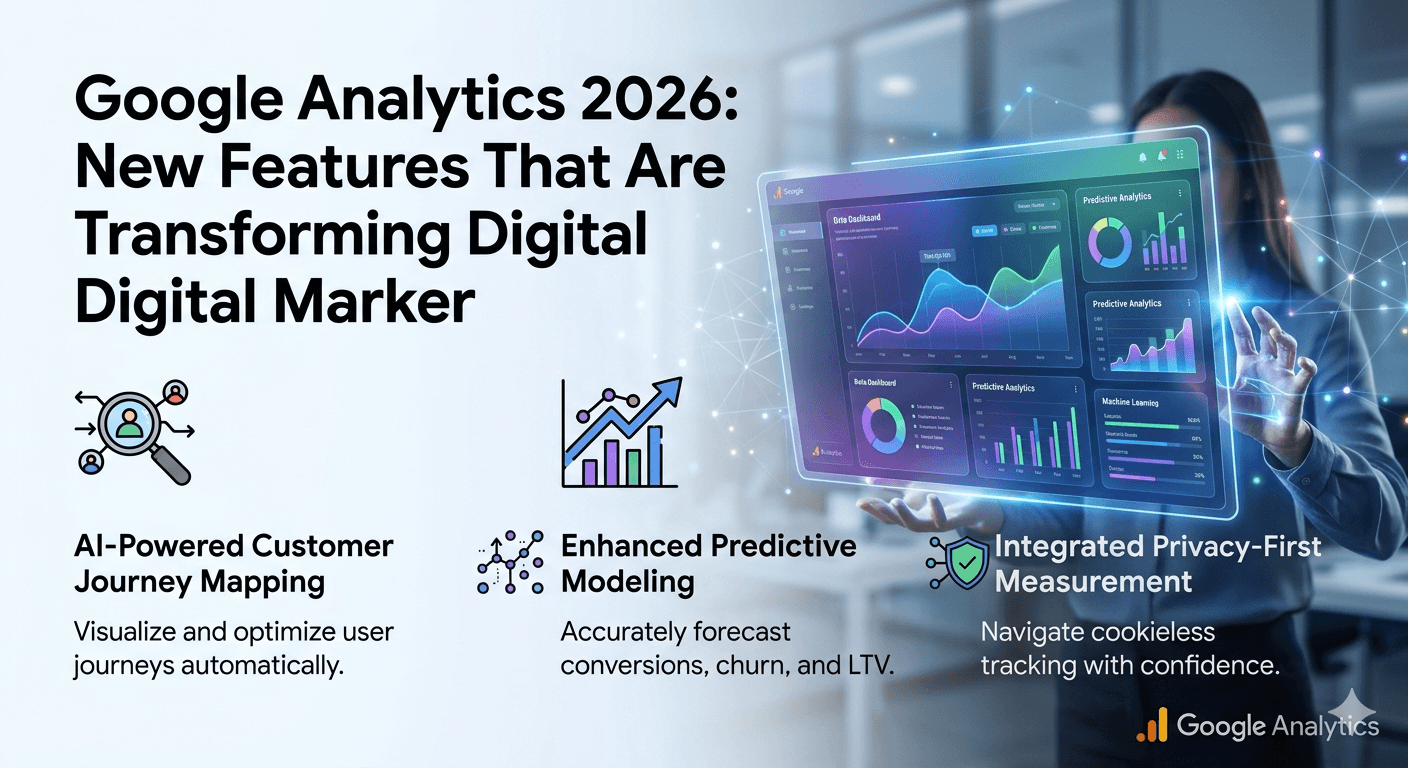
Google Analytics 2026: What’s Changing in Digital Marketing
In 2026, Google Analytics has moved beyond being just a reporting tool. It is becoming an AI-driven decision and marketing optimization platform, deeply integrated with ads, automation, and predictive insights.
Instead of only telling you what happened, GA4 now increasingly focuses on:
- Why it happened
- What will happen next
- What you should do about it
🤖 1. Analytics Advisor (AI-powered insights)
One of the biggest changes is the introduction of an AI assistant inside GA4.
Google Analytics now includes Analytics Advisor, a Gemini-powered assistant that:
- Answers questions in natural language (“Why did traffic drop last week?”)
- Builds instant charts and visual reports
- Detects anomalies automatically (spikes, drops, conversion changes)
- Guides setup and tracking configuration
👉 Impact on marketers:
You don’t need to dig through multiple reports anymore—insights come directly from conversational queries.
📊 2. Smarter audience & predictive modeling
GA4 is becoming much stronger in predictive analytics and segmentation.
Key upgrades include:
- Predictive audiences (likelihood to buy, churn, or return)
- High-value customer identification (LTV-based targeting)
- Disengaged user detection for reactivation campaigns
👉 Impact:
Marketers can now run AI-driven segmentation instead of manual audience building.
📣 3. Deeper integration with Google Ads & platforms
GA4 is no longer isolated—it is now tightly connected with advertising ecosystems.
New integrations allow:
- Real-time feedback loops with Google Ads campaigns
- Better attribution for multi-channel journeys
- Improved campaign optimization using GA4 data signals
👉 Impact:
Campaigns (especially Performance Max) are increasingly optimized directly using GA4 behavioral data.
📉 4. Advanced benchmarking & business intelligence
GA4 now offers improved benchmarking features:
- Compare your performance vs industry peers
- Includes both percentage metrics and absolute numbers (revenue, users, conversions)
- AI-adjusted performance ranges based on traffic size
👉 Impact:
Marketers can finally answer:
👉 “Am I actually doing well compared to my industry?”
🔐 5. Privacy-first data modeling (without losing insights)
Due to stricter privacy regulations, GA4 continues evolving its modeling system:
- More reliance on aggregated and modeled data
- Reduced dependency on individual user tracking
- Enhanced consent-based measurement
👉 Impact:
More privacy compliance, but still usable insights even with limited cookies.
🔗 6. Expanded cross-channel cost tracking
GA4 now supports importing ad cost data from multiple platforms like:
- Meta Ads
- TikTok Ads
- Pinterest Ads
- Reddit Ads
👉 Impact:
Marketers can now see true ROI across all paid channels in one place.
🧠 What this means for digital marketers in 2026
The role of GA4 is shifting:
Before:
- Reporting tool
- Manual analysis
- Dashboard checking
Now:
- AI marketing assistant
- Predictive decision engine
- Cross-channel optimization hub
📌 Final takeaway
In 2026, Google Analytics is no longer just about measuring traffic—it’s becoming a strategic AI system for marketing decisions, where automation, prediction, and integration drive most of the value.