
What Is Machine Learning and How Does It Work?
Machine Learning is one of the most important technologies behind today’s Artificial Intelligence revolution. From Netflix recommendations and Google search results to self-driving cars and virtual assistants, machine learning powers many of the digital experiences we use every day.
But what exactly is machine learning, and how does it work? In this beginner-friendly guide, we’ll break down the basics and explain why machine learning is transforming industries around the world.
What Is Machine Learning?
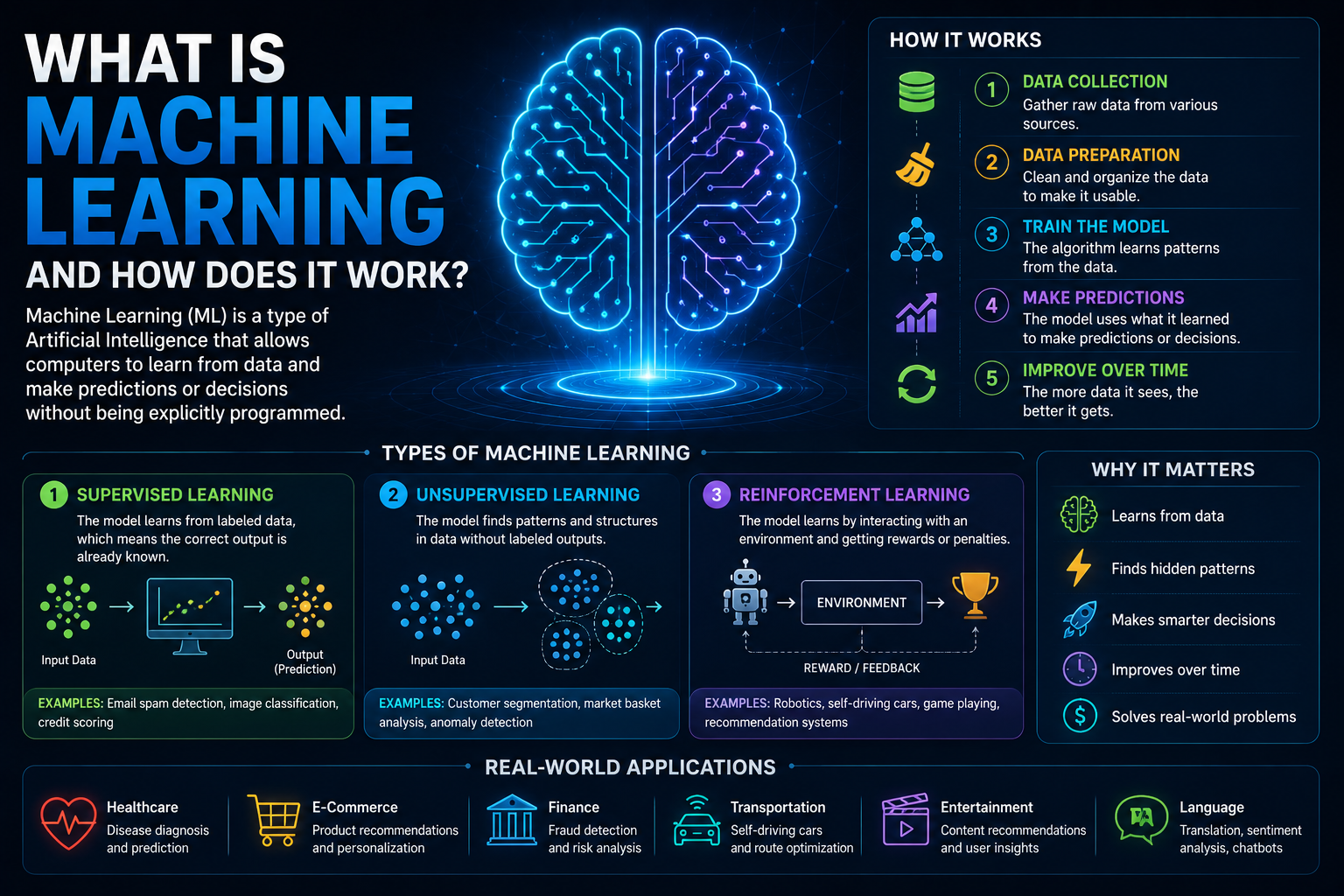
Machine Learning (ML) is a branch of Artificial Intelligence that allows computers to learn from data and improve their performance without being explicitly programmed for every task.
Instead of following fixed instructions, machine learning systems identify patterns in data and use those patterns to make predictions or decisions.
For example, a machine learning model can learn to recognize spam emails by analyzing thousands of examples of spam and non-spam messages.
How Does Machine Learning Work?
At its core, machine learning follows a simple process:
1. Data Collection
The system gathers large amounts of data. This could include text, images, videos, customer information, or sensor data.
2. Data Preparation
The collected data is cleaned and organized to remove errors and inconsistencies.
3. Training the Model
The machine learning algorithm analyzes the data and learns patterns, relationships, and trends.
4. Making Predictions
Once trained, the model can make predictions or decisions based on new information.
5. Continuous Improvement
As more data becomes available, the model can continue learning and improving its accuracy over time.
This ability to learn from experience is what makes machine learning so powerful.
Types of Machine Learning
There are three main types of machine learning used today.
Supervised Learning
In supervised learning, the model is trained using labeled data where the correct answer is already known.
Examples include:
- Email spam detection
- House price prediction
- Image classification
Unsupervised Learning
Unsupervised learning works with data that has no labels. The goal is to discover hidden patterns and relationships.
Examples include:
- Customer segmentation
- Market analysis
- Recommendation systems
Reinforcement Learning
Reinforcement learning allows systems to learn through trial and error by receiving rewards or penalties for their actions.
Examples include:
- Robotics
- Video game AI
- Self-driving vehicles
Real-World Applications of Machine Learning
Machine learning is already impacting many industries.
Healthcare
AI helps doctors diagnose diseases, analyze medical images, and develop personalized treatments.
Finance
Banks use machine learning to detect fraud, assess risk, and automate trading decisions.
E-Commerce
Online stores use recommendation engines to suggest products based on customer behavior.
Transportation
Self-driving vehicles rely heavily on machine learning to navigate and make real-time decisions.
Marketing
Businesses use machine learning to analyze customer data, personalize campaigns, and improve sales performance.
Machine Learning vs Artificial Intelligence
Many people use the terms interchangeably, but they are not exactly the same.
Artificial Intelligence is the broader field focused on creating intelligent systems.
Machine Learning is a subset of AI that allows systems to learn from data.
In simple terms, machine learning is one of the technologies that makes modern AI possible.
Why Machine Learning Matters
Machine learning enables computers to process enormous amounts of information much faster than humans. It helps organizations automate tasks, improve decision-making, and discover insights hidden within data.
As data continues to grow, machine learning will become even more important across industries and everyday life.
Final Thoughts
Machine Learning is one of the driving forces behind the AI revolution. By learning from data, machine learning systems can identify patterns, make predictions, and improve their performance over time.
Whether it’s healthcare, finance, education, transportation, or business, machine learning is already shaping the future. Understanding how it works is an essential step for anyone interested in technology, Artificial Intelligence, and the digital world of tomorrow.