
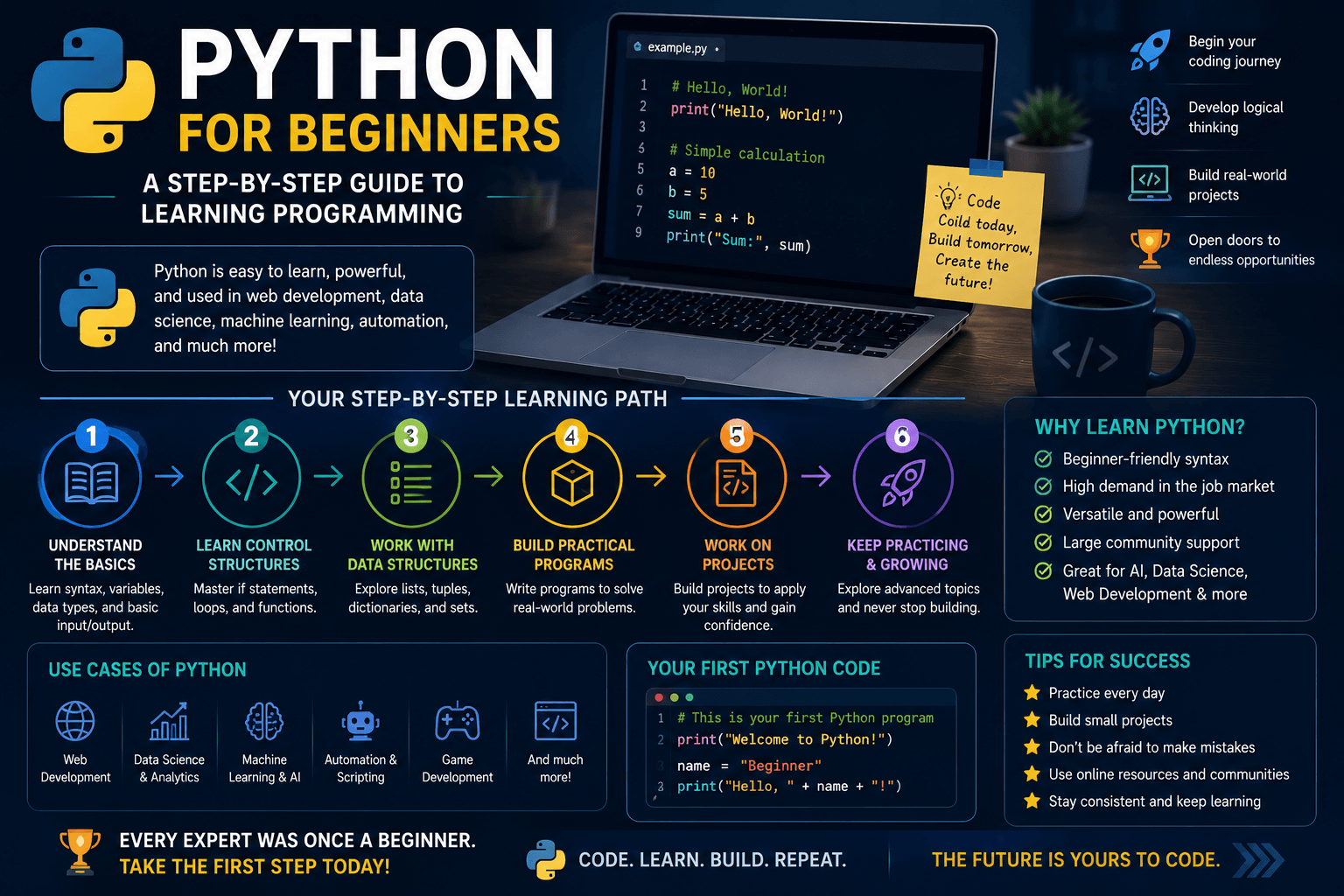
Python for Beginners: A Step-by-Step Guide to Learning Programming
Python has become one of the most popular programming languages in the world—and for good reason. Its simple syntax, readability, and versatility make it the perfect choice for beginners who want to learn programming. Whether you’re interested in web development, data science, artificial intelligence, automation, or software engineering, Python provides a strong foundation for your coding journey.
In this guide, we’ll walk through the essential steps to start learning Python and building real-world programming skills.
Why Choose Python?
Python is often recommended as a first programming language because it is easy to read and write. Unlike many other languages, Python uses clear and simple syntax that allows beginners to focus on programming concepts rather than complicated rules.
Python is widely used in:
- Web development
- Data science
- Artificial Intelligence
- Machine Learning
- Automation
- Cybersecurity
- Software development
Learning Python opens doors to numerous career opportunities in technology.
Step 1: Understand the Basics
Every programmer starts with the fundamentals. Begin by learning:
Core concepts:
- Variables
- Data types
- Input and output
- Operators
- Comments
For example:
name = "Python"
print("Hello, " + name)
These building blocks form the foundation of every Python program.
Step 2: Learn Control Structures
Once you’re comfortable with the basics, it’s time to learn how programs make decisions and repeat actions.
Important topics:
- if statements
- else conditions
- for loops
- while loops
These concepts allow programs to respond to different situations and perform repetitive tasks efficiently.
Step 3: Work with Functions
Functions help organize code into reusable blocks.
Example:
def greet(name):
    print("Hello,", name)

greet("Teodora")
Functions make programs easier to maintain and reduce duplicate code.
Step 4: Explore Data Structures
Data structures allow programmers to store and organize information.
Essential Python data structures:
- Lists
- Tuples
- Dictionaries
- Sets
Understanding these structures is crucial for solving real-world programming problems efficiently.
Step 5: Build Small Projects
The best way to learn programming is by creating practical projects.
Beginner project ideas:
- Calculator
- To-do list
- Password generator
- Unit converter
- Quiz game
Projects help reinforce concepts and build confidence.
Step 6: Learn Python Libraries
One of Python’s greatest strengths is its massive ecosystem of libraries.
Popular libraries include:
- Pandas for data analysis
- NumPy for scientific computing
- Matplotlib for visualization
- Flask for web development
- TensorFlow for AI and machine learning
Libraries allow developers to accomplish complex tasks with minimal code.
Step 7: Use AI to Learn Faster
In 2026, learning programming has become easier thanks to AI tools. Platforms like ChatGPT, Claude, Gemini, and GitHub Copilot can explain code, answer questions, generate examples, and help debug errors.
AI can act as a personal tutor, helping beginners understand difficult concepts and progress more quickly.
Common Mistakes Beginners Should Avoid
Many new programmers make the same mistakes:
- Trying to learn too many languages at once
- Memorizing code instead of understanding concepts
- Avoiding projects
- Giving up after encountering errors
Remember that debugging is a normal part of programming and one of the best ways to learn.
Final Thoughts
Python remains one of the best programming languages for beginners in 2026. Its simplicity, versatility, and strong community support make it an excellent choice for anyone interested in technology.
Start with the basics, build small projects, practice consistently, and don’t be afraid to make mistakes. Every experienced developer started exactly where you are today. With patience and persistence, Python can become your gateway to a rewarding career in programming, data science, AI, and software development.