
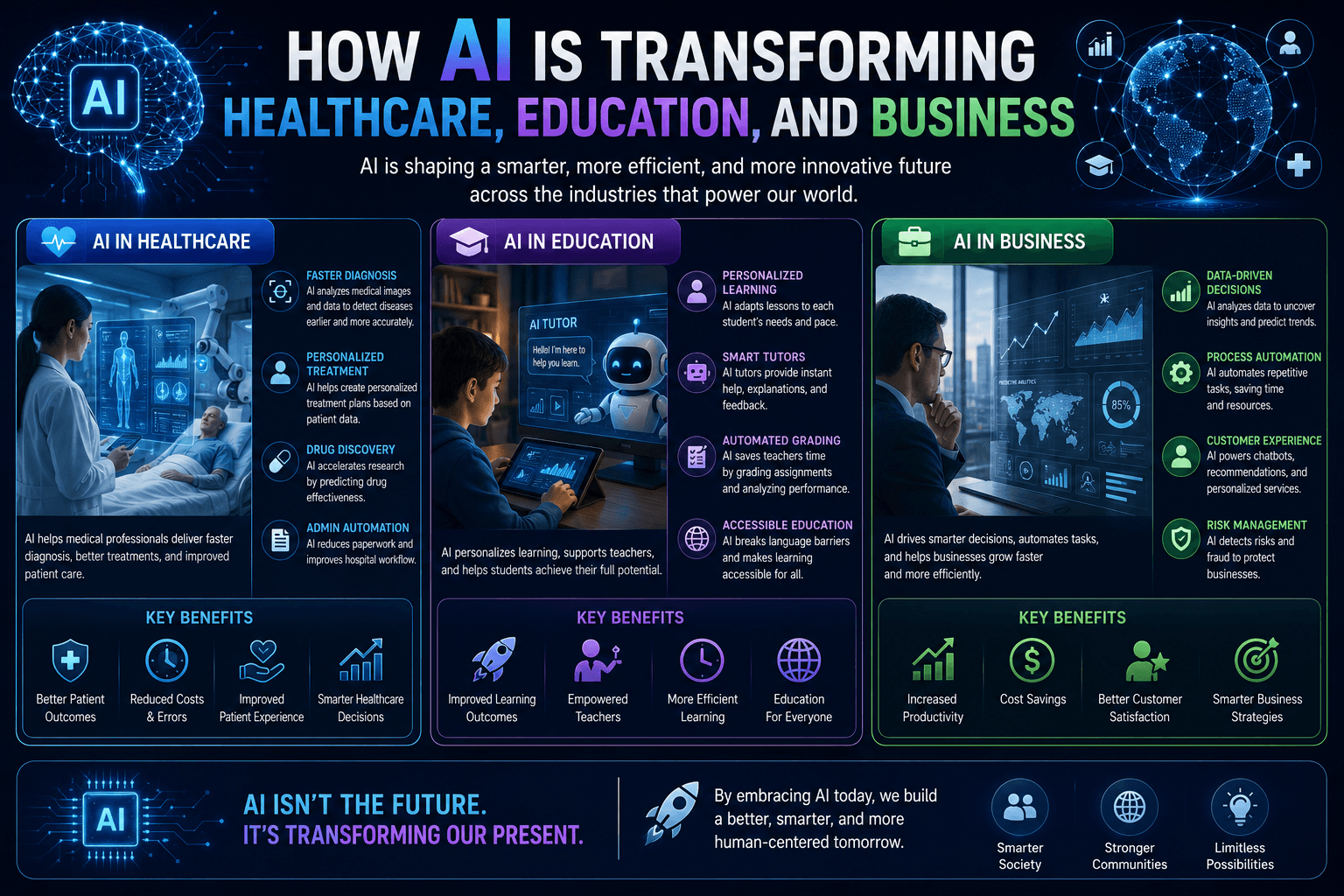
How AI Is Transforming Healthcare, Education, and Business
Artificial Intelligence is no longer a futuristic concept—it is already reshaping the world around us. From helping doctors diagnose diseases to personalizing education and streamlining business operations, AI is becoming one of the most influential technologies of the 21st century.
As AI systems become more advanced and accessible, industries are discovering new ways to improve efficiency, reduce costs, and deliver better experiences. Among the sectors experiencing the greatest transformation are healthcare, education, and business.
AI in Healthcare: Smarter, Faster, Better Care
Healthcare is one of the most promising areas for AI innovation. Medical professionals are using AI-powered tools to analyze vast amounts of data, identify patterns, and support clinical decision-making.
Key applications include:
- Early disease detection
- Medical image analysis
- Personalized treatment plans
- Drug discovery
- Virtual health assistants
AI can analyze X-rays, MRIs, and other medical scans with remarkable speed and accuracy, helping doctors identify potential issues earlier. In many cases, AI serves as a valuable second opinion that improves diagnostic confidence.
As technology continues to evolve, AI has the potential to make healthcare more accessible, affordable, and effective for patients worldwide.
AI in Education: Personalized Learning for Everyone
Traditional education often follows a one-size-fits-all approach, but every student learns differently. AI is helping educators create more personalized learning experiences tailored to individual needs and abilities.
AI is improving education through:
- Intelligent tutoring systems
- Personalized learning paths
- Automated grading
- Real-time feedback
- Language translation tools
AI-powered platforms can identify a student’s strengths and weaknesses, then adjust lessons accordingly. This allows learners to progress at their own pace while receiving targeted support.
Teachers also benefit from AI by reducing administrative tasks and gaining insights into student performance, allowing them to focus more on teaching and mentorship.
AI in Business: Driving Efficiency and Growth
Businesses of all sizes are embracing AI to automate processes, improve customer experiences, and make smarter decisions.
Common business applications include:
- Customer service automation
- Marketing optimization
- Sales forecasting
- Data analysis
- Workflow automation
AI chatbots can provide instant customer support, while predictive analytics helps organizations understand trends and make informed decisions. Marketing teams use AI to generate content, personalize campaigns, and analyze performance more effectively.
By automating repetitive tasks, businesses can save time, reduce costs, and increase productivity.
The Benefits of AI Across Industries
Although healthcare, education, and business have different goals, they all benefit from AI in similar ways.
AI helps organizations:
- Improve efficiency
- Reduce manual work
- Enhance decision-making
- Deliver personalized experiences
- Increase productivity
- Lower operational costs
These advantages explain why AI adoption continues to grow across nearly every sector.
Challenges and Ethical Considerations
Despite its benefits, AI also presents challenges. Issues such as data privacy, security, transparency, and algorithmic bias must be carefully addressed.
Organizations implementing AI need to ensure that systems are used responsibly and that human oversight remains part of important decisions.
Building trust in AI will be essential as adoption expands.
The Future of AI
The next decade is expected to bring even more powerful AI technologies. We can expect smarter healthcare systems, highly personalized education platforms, and businesses that operate with unprecedented efficiency.
Rather than replacing people, AI will increasingly act as a partner that enhances human capabilities and helps solve complex problems.
Final Thoughts
Artificial Intelligence is transforming healthcare, education, and business in ways that were unimaginable just a few years ago. From improving patient care and enhancing learning experiences to optimizing business operations, AI is creating opportunities for innovation across every industry.
As technology continues to advance, those who embrace AI and learn how to work alongside it will be best positioned to thrive in the digital future. The AI revolution is not coming—it is already here, and its impact is only beginning.