
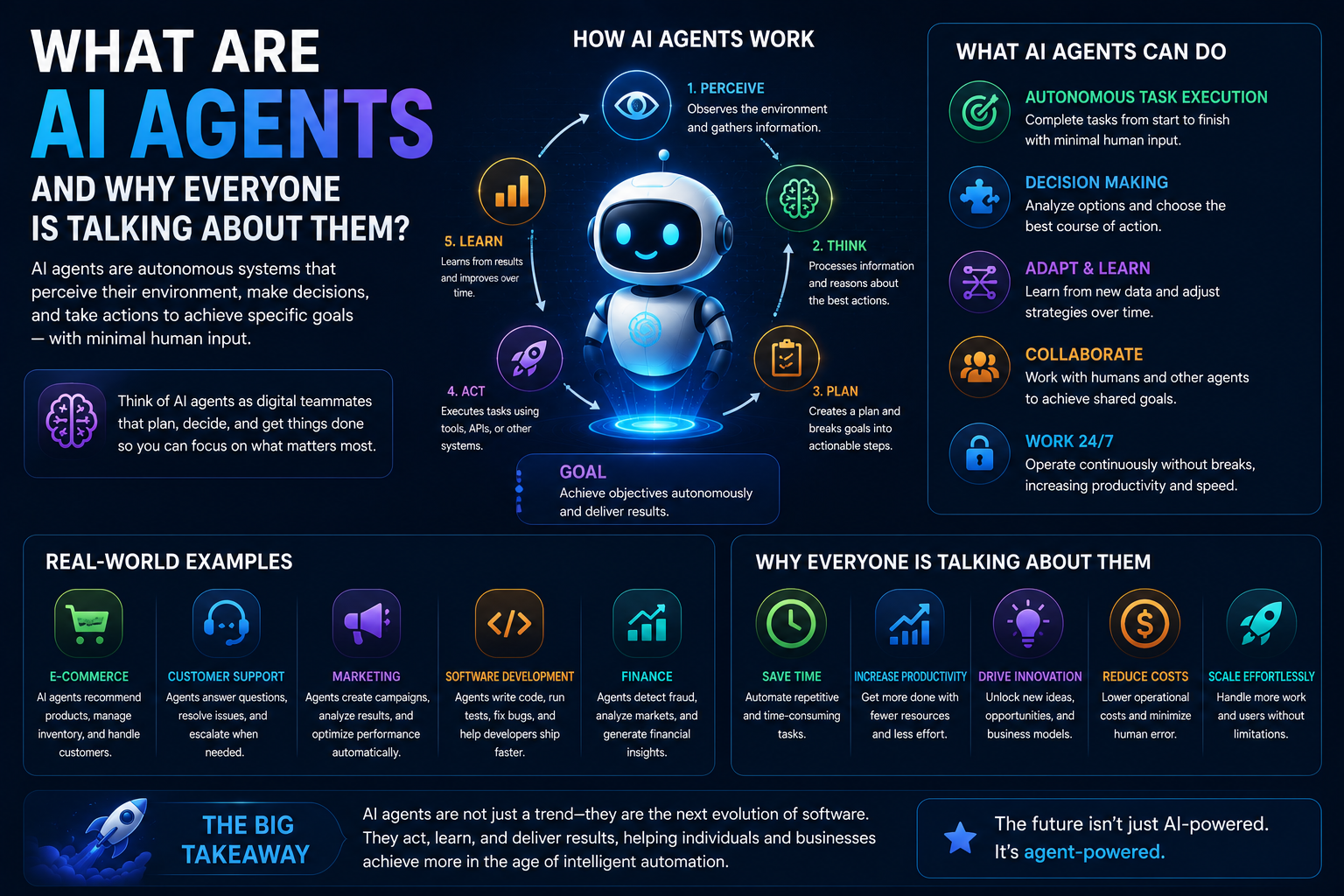
What Are AI Agents and Why Everyone Is Talking About Them?
Artificial Intelligence is evolving rapidly, and one of the most exciting developments in 2026 is the rise of AI agents. While many people are familiar with AI chatbots like ChatGPT, AI agents take things a step further. Instead of simply answering questions, AI agents can perform tasks, make decisions, interact with software, and work toward specific goals with minimal human involvement.
As businesses and individuals discover their potential, AI agents are quickly becoming one of the hottest topics in technology.
What Is an AI Agent?
An AI agent is an intelligent software system designed to complete tasks autonomously. Unlike traditional AI assistants that respond to prompts, AI agents can plan actions, execute multiple steps, and adapt their behavior based on changing circumstances.
Think of an AI agent as a digital employee rather than just a chatbot.
For example, instead of asking an AI to summarize a report, you could ask an AI agent to research a topic, collect information, generate a report, and email the final results automatically.
How AI Agents Work
AI agents combine several technologies, including large language models, memory systems, planning capabilities, and software integrations.
A typical AI agent can:
- Understand objectives
- Break tasks into smaller steps
- Use tools and applications
- Analyze information
- Make decisions
- Complete workflows
This allows agents to handle complex tasks that would normally require significant human effort.
AI Agents vs Traditional Chatbots
Many people confuse AI agents with chatbots, but there are important differences.
Traditional Chatbots:
- Respond to user questions
- Wait for instructions
- Perform limited actions
AI Agents:
- Act independently
- Complete multi-step tasks
- Use external tools
- Make decisions based on goals
- Continuously improve workflows
In simple terms, chatbots answer questions, while AI agents take action.
Real-World Uses of AI Agents
AI agents are already being used across multiple industries.
In Business
Companies use AI agents to automate administrative work, manage schedules, generate reports, and improve customer service.
In Marketing
AI agents can research competitors, create content calendars, generate social media posts, and monitor campaign performance.
In Software Development
Developers use AI agents to write code, identify bugs, generate documentation, and automate testing processes.
In Customer Support
AI agents can resolve common customer issues, process requests, and provide 24/7 assistance without human intervention.
Why Businesses Are Excited About AI Agents
One of the biggest advantages of AI agents is their ability to save time and reduce costs.
Benefits include:
- Increased productivity
- Faster task completion
- Reduced manual work
- Improved scalability
- Better decision-making
Organizations can automate repetitive processes and allow employees to focus on higher-value activities.
Challenges and Limitations
Despite their potential, AI agents are not perfect.
Current challenges include:
- Accuracy issues
- Security concerns
- Limited understanding of complex business contexts
- Dependence on high-quality data
- Need for human oversight
For now, AI agents work best when combined with human expertise rather than operating completely independently.
The Future of AI Agents
Experts believe AI agents will become increasingly capable over the next few years. Future agents may manage entire business processes, coordinate teams of AI systems, and perform tasks that currently require multiple software applications.
As technology advances, AI agents could become as common in the workplace as email and spreadsheets are today.
Final Thoughts
AI agents represent the next evolution of Artificial Intelligence. By moving beyond simple conversations and into autonomous action, they have the potential to transform how businesses operate and how people work.
While challenges remain, the ability of AI agents to automate complex workflows, increase productivity, and support decision-making explains why everyone is talking about them. As adoption grows, AI agents are likely to become one of the most important technologies shaping the future of work and innovation.