
AI Safety vs Innovation: The Global Debate Around Advanced AI Models in 2026
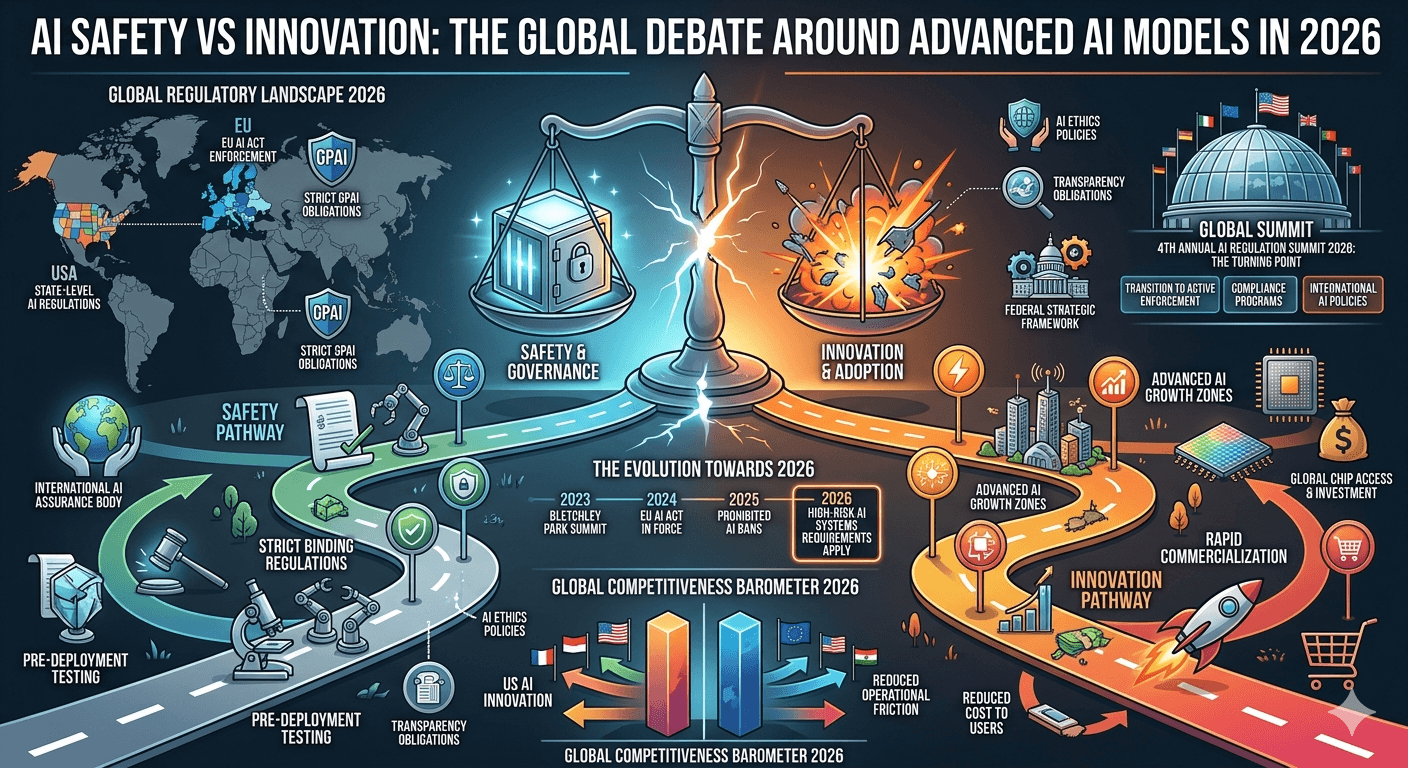
Artificial intelligence is evolving faster than ever, and with every new breakthrough comes a growing debate: should the world focus more on rapid AI innovation or stronger AI safety regulations? In 2026, this discussion has become one of the most important topics in technology, politics, and business as advanced AI models continue to reshape industries across the globe.
Major AI organizations such as OpenAI, Google, Anthropic, and Microsoft are investing billions into increasingly powerful AI systems. These models are capable of generating text, images, code, video, and complex reasoning at levels never seen before. While these advancements create enormous opportunities, they also raise serious concerns about how AI should be controlled and regulated.
Supporters of rapid innovation argue that AI can solve major global problems. Advanced models are already improving healthcare research, accelerating scientific discovery, automating business processes, and increasing productivity. Companies and governments believe that slowing down AI development could reduce competitiveness and limit economic growth, especially as global competition intensifies.
On the other side of the debate, AI safety researchers warn that powerful AI systems may introduce risks that society is not fully prepared for. Concerns include misinformation, deepfakes, cybersecurity threats, job displacement, privacy issues, and the possibility of autonomous systems making harmful decisions without sufficient human oversight.
One of the biggest fears involves uncontrolled AI behavior. As AI models become more autonomous and capable of handling complex tasks independently, experts question whether humans will always be able to fully understand or control their decision-making processes. This has led to growing calls for international AI regulations and safety standards.
Governments around the world are responding differently. Some countries are pushing for strict AI oversight, transparency requirements, and safety testing before deployment. Others prioritize innovation and fear that excessive regulation could slow technological progress and allow competitors to gain an advantage in the global AI race.
Another key issue is military and geopolitical use of AI. Advanced AI systems are increasingly being explored for cybersecurity, surveillance, intelligence analysis, and autonomous defense technologies. This raises ethical concerns about how AI could influence future conflicts and global power dynamics.
The debate is also affecting the tech industry itself. Many AI companies are now creating dedicated safety teams focused on alignment, transparency, and responsible development. However, critics argue that commercial pressure and competition may still push companies to release increasingly powerful systems too quickly.
Final Thoughts
The conflict between AI safety and innovation is likely to define the future of artificial intelligence in the coming years. While advanced AI models offer extraordinary opportunities for progress, they also require careful oversight and responsible development. Finding the right balance between innovation and safety may become one of the most important global challenges of the AI era.