
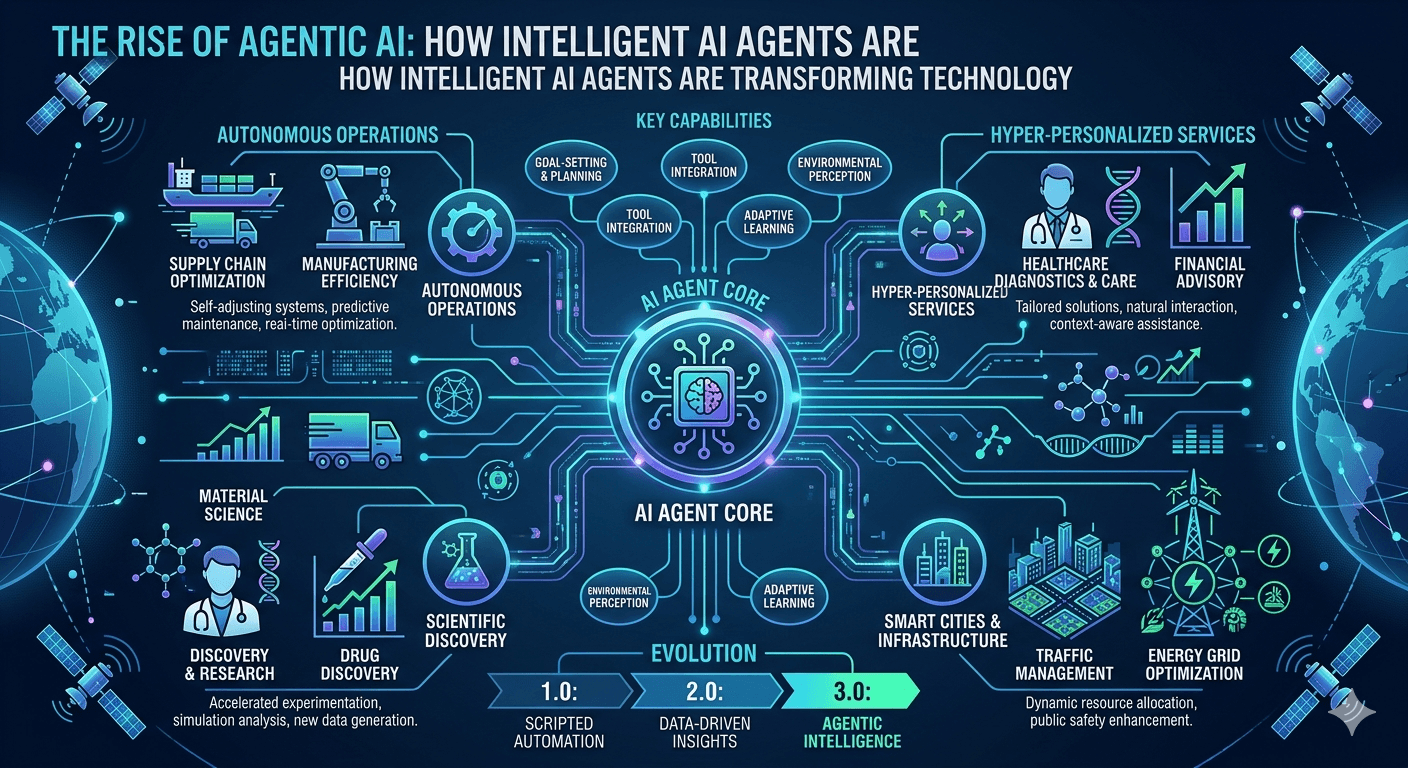
The Rise of Agentic AI: How Intelligent AI Agents Are Transforming Technology
Artificial intelligence is entering a new era known as Agentic AI — a major shift from simple chatbots and assistants toward intelligent systems capable of acting independently, making decisions, and completing complex tasks with minimal human guidance. In 2026, AI agents are rapidly becoming one of the most important trends in technology, reshaping how businesses, developers, and everyday users interact with digital systems.
Traditional AI systems mainly respond to direct instructions. They answer questions, generate text, or provide recommendations when prompted. Agentic AI goes much further. These intelligent agents can plan tasks, analyze situations, adapt to changing conditions, and take action automatically to achieve specific goals.
Companies like OpenAI, Google, and Anthropic are investing heavily in AI agents capable of managing workflows, automating research, handling customer support, writing code, and even operating software tools independently. Instead of simply generating responses, these systems are learning how to “think” through multi-step problems and execute actions across different applications.
One of the biggest advantages of Agentic AI is productivity. AI agents can automate repetitive and time-consuming tasks that once required constant human attention. Businesses are already using intelligent agents for scheduling, email management, market analysis, project coordination, and data processing. This allows employees to focus more on strategy, creativity, and decision-making.
Software development is another area experiencing major transformation. AI coding agents can now write, test, debug, and optimize code almost autonomously. Developers increasingly collaborate with AI systems rather than using them as simple assistants. This is speeding up software production and changing the future of programming itself.
Agentic AI is also influencing customer experience. Advanced AI agents can understand user intent, remember previous interactions, and solve problems more naturally. Instead of basic support bots, businesses are deploying intelligent systems capable of managing entire customer conversations and workflows.
The rise of AI agents is closely connected to advances in large language models, cloud computing, and multimodal AI systems. Modern AI can now process text, images, audio, and structured data together, giving agents broader understanding and stronger decision-making abilities.
However, this technological shift also raises concerns. Experts warn about issues related to privacy, security, misinformation, and overdependence on autonomous systems. As AI agents gain more control over digital processes, ensuring transparency and responsible development becomes increasingly important.
Final Thoughts
Agentic AI represents one of the biggest technological transformations of the decade. Intelligent AI agents are moving beyond passive assistance and becoming active participants in digital workflows. As businesses and individuals adopt these systems more widely, Agentic AI is expected to redefine productivity, automation, and the relationship between humans and technology in the years ahead.