
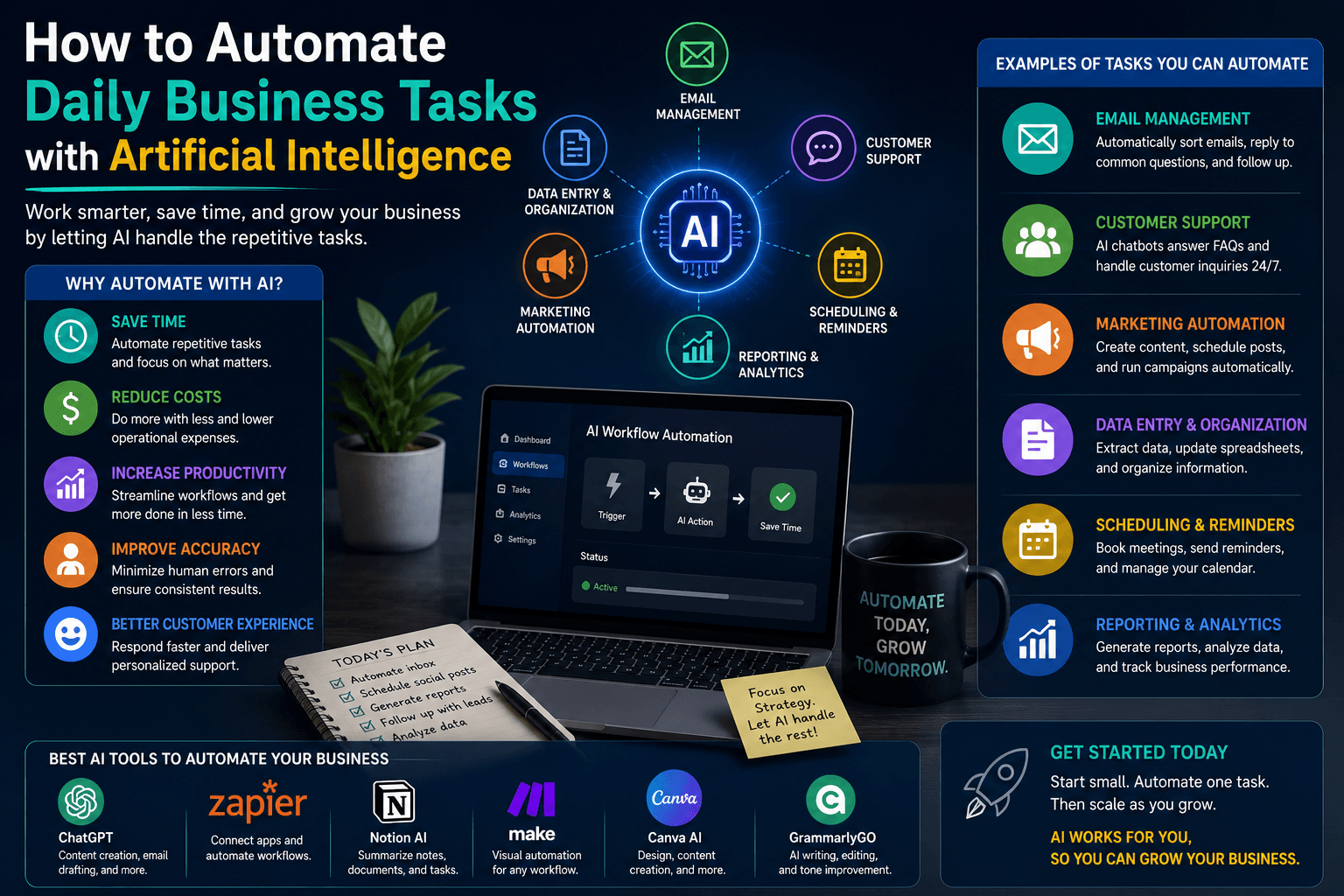
How to Automate Daily Business Tasks with Artificial Intelligence
Running a business often means juggling dozens of repetitive tasks every day. From managing emails and scheduling meetings to creating content and handling customer inquiries, these activities consume valuable time that could be spent on growth and strategy. Fortunately, Artificial Intelligence is making it easier than ever to automate routine work and improve productivity.
In 2026, AI tools have become accessible, affordable, and powerful enough for businesses of all sizes. By automating daily tasks, companies can save time, reduce costs, and focus on what truly matters.
Why Business Automation Matters
Many businesses lose hours every week on repetitive administrative work. While these tasks are necessary, they often prevent teams from focusing on innovation, customer relationships, and revenue-generating activities.
AI helps eliminate these bottlenecks by handling routine processes quickly and accurately. The result is a more efficient workflow and a more productive team.
Automating Email Management
Email remains one of the most time-consuming business activities. AI tools can draft responses, prioritize important messages, summarize conversations, and even suggest follow-up actions.
Benefits:
- Faster response times
- Better organization
- Reduced inbox overload
- Improved communication
Tools like ChatGPT and Microsoft Copilot can significantly reduce the time spent managing emails.
Streamlining Customer Support
Customers expect quick answers and 24/7 availability. AI-powered chatbots can handle frequently asked questions, schedule appointments, process requests, and provide instant support.
This allows businesses to improve customer satisfaction without increasing support costs.
Common Automation Tasks:
- Answering FAQs
- Appointment booking
- Product recommendations
- Order tracking
Creating Marketing Content Automatically
Content creation is essential for business growth, but producing blogs, social media posts, newsletters, and advertisements takes time.
AI can generate content ideas, write first drafts, create captions, and even design visual assets.
Marketing Tasks AI Can Automate:
- Blog writing
- Social media content
- Email campaigns
- Product descriptions
- Advertising copy
Businesses can maintain a consistent marketing presence while reducing workload.
Automating Scheduling and Meetings
Coordinating meetings often involves multiple emails and calendar updates. AI scheduling assistants can automatically find available time slots, send invitations, and manage reminders.
This reduces administrative work and improves team efficiency.
Data Analysis and Reporting
Many organizations collect large amounts of data but struggle to turn it into actionable insights. AI tools can analyze sales performance, customer behavior, website traffic, and operational metrics in seconds.
Instead of manually creating reports, businesses receive real-time insights that support faster decision-making.
Best AI Tools for Business Automation
Several AI platforms are helping businesses automate daily operations:
ChatGPT
Ideal for content creation, communication, and productivity.
Zapier
Connects applications and automates workflows between different platforms.
Notion AI
Helps organize projects, generate documentation, and manage team knowledge.
Gemini
Enhances productivity within Google Workspace.
Microsoft Copilot
Automates tasks across Word, Excel, Outlook, and Teams.
How to Start with AI Automation
The best approach is to start small. Identify the tasks that consume the most time and evaluate which AI tools can automate them.
Focus on:
- Repetitive tasks
- High-volume processes
- Administrative activities
- Customer communication
- Content production
As you gain experience, you can expand automation across additional areas of your business.
Final Thoughts
Artificial Intelligence is transforming the way businesses operate. By automating daily tasks such as email management, customer support, content creation, scheduling, and reporting, companies can improve efficiency and free up valuable time.
The goal of AI is not to replace employees but to help them work smarter. Businesses that embrace automation in 2026 will be better positioned to increase productivity, reduce costs, and stay competitive in an increasingly digital marketplace.