
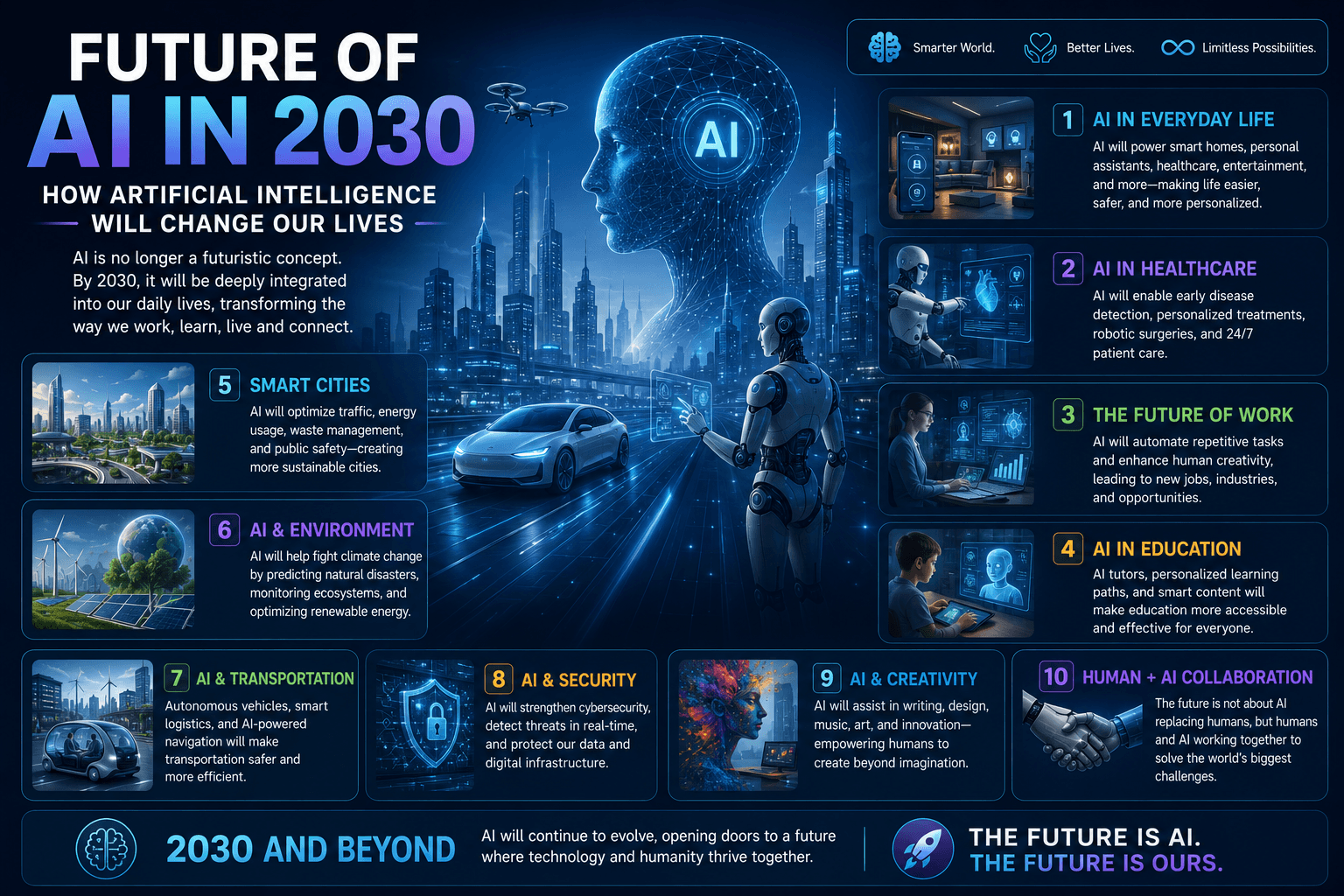
The Future of AI in 2030: How Artificial Intelligence Will Change Our Lives
Artificial Intelligence is advancing at a remarkable pace, transforming how we work, communicate, learn, and solve problems. By 2030, AI is expected to become deeply integrated into everyday life, influencing nearly every industry and aspect of society. While today’s AI tools already help us create content, write code, and automate tasks, the next generation of AI will be even more powerful, personalized, and accessible.
The future of AI is not just about technology—it’s about how humans and intelligent systems will work together to create a smarter world.
AI in Everyday Life
By 2030, AI will become an invisible assistant that supports daily activities. Smart devices, virtual assistants, and connected systems will anticipate our needs and provide personalized recommendations.
AI will help with:
- Managing schedules
- Shopping and budgeting
- Health monitoring
- Travel planning
- Smart home automation
Many routine tasks that currently require manual effort will be automated, saving time and improving convenience.
The Future of Work
AI will dramatically reshape the workplace. Rather than replacing most jobs, AI will automate repetitive tasks and allow employees to focus on creativity, strategy, and problem-solving.
Workers will increasingly collaborate with AI assistants that can:
- Analyze data
- Draft reports
- Create presentations
- Automate workflows
- Support decision-making
Organizations that embrace AI will become more productive and competitive.
Healthcare Revolution
Healthcare is expected to be one of the industries most transformed by AI.
Future applications include:
- Early disease detection
- Personalized treatment plans
- AI-assisted surgeries
- Drug discovery
- Virtual healthcare assistants
Doctors and healthcare professionals will use AI to improve diagnosis accuracy and deliver better patient outcomes.
Personalized Education
Traditional education often follows a one-size-fits-all model. By 2030, AI-powered learning systems will provide personalized education experiences tailored to each student’s strengths, weaknesses, and learning pace.
AI tutors will:
- Adapt lessons automatically
- Provide instant feedback
- Identify knowledge gaps
- Support lifelong learning
This could make education more accessible and effective for millions of learners worldwide.
Smarter Cities and Transportation
Cities will become increasingly connected through AI-driven infrastructure.
AI will help optimize:
- Traffic management
- Public transportation
- Energy consumption
- Waste collection
- Public safety
Autonomous vehicles and intelligent transportation systems could reduce accidents, improve efficiency, and decrease congestion.
AI and Creativity
Contrary to fears that AI will replace human creativity, future AI systems are likely to become powerful creative partners.
Artists, writers, designers, musicians, and content creators will use AI to generate ideas, accelerate workflows, and explore new forms of expression.
Human imagination combined with AI capabilities may unlock entirely new creative possibilities.
Ethical Challenges and Responsible AI
As AI becomes more powerful, ethical concerns will become increasingly important. Issues such as privacy, transparency, security, and bias must be addressed to ensure AI benefits society as a whole.
Governments, businesses, and technology leaders are already working on regulations and frameworks to promote responsible AI development.
Building trust will be critical to widespread adoption.
Human and AI Collaboration
Perhaps the most important trend for 2030 is the shift toward collaboration between humans and AI. The future is not about machines replacing people—it’s about people using AI to become more capable and productive.
The most successful individuals and organizations will be those that learn how to work effectively alongside intelligent systems.
Final Thoughts
By 2030, Artificial Intelligence will touch nearly every aspect of our lives. From healthcare and education to business, transportation, and entertainment, AI will create opportunities that were once unimaginable.
While challenges remain, the potential benefits are enormous. The future of AI is not simply about smarter technology—it’s about creating a world where humans and machines work together to solve problems, improve quality of life, and drive innovation on a global scale.
The AI revolution is only beginning, and the next decade promises to be one of the most transformative periods in human history.