
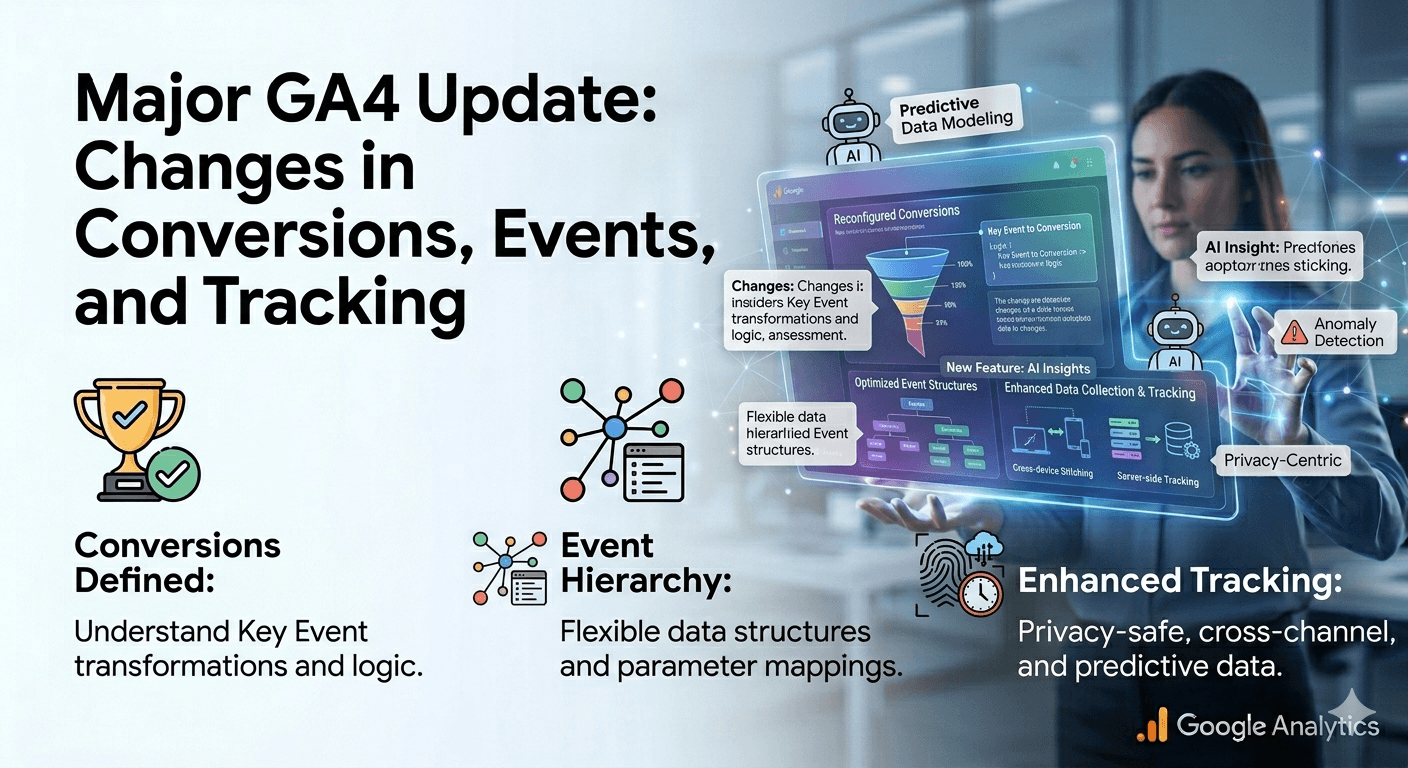
Major GA4 Update Changes in Conversions, Events, and Tracking
Google Analytics 4 (GA4) continues to evolve in 2026, and the biggest impact for marketers is in how conversions, events, and tracking are defined and measured. The platform is moving further away from traditional session-based tracking and becoming a fully event-driven, AI-enhanced measurement system.
📌 1. Conversions are now fully event-based
One of the most important structural changes in GA4 is that everything is an event, and conversions are no longer a separate tracking system.
Key updates:
- Any event can now be marked as a conversion with one toggle
- No distinction between “goal types” like in Universal Analytics
- Flexible conversion modeling (purchase, sign-up, scroll depth, video engagement)
- Better support for micro-conversions (e.g., add-to-cart, form start)
👉 Impact:
Marketers gain more control, but must carefully choose which events truly represent business value, otherwise data becomes noisy.
📊 2. Enhanced event tracking with AI suggestions
GA4 now uses AI-assisted event recommendations:
- Automatically suggests missing key events
- Detects important user behaviors (e.g., rage clicks, drop-offs)
- Improved auto-event detection without manual tagging
Enhanced Measurement has also expanded:
- Scroll tracking is more precise
- Outbound clicks and file downloads are more accurate
- Video engagement tracking includes deeper milestones (25%, 50%, 75%, 100%)
👉 Impact:
Less manual setup, but better event coverage across websites and apps.
🔄 3. Smarter attribution for conversions
GA4’s attribution system has become more advanced:
- Data-driven attribution is now the default
- Cross-device tracking is more stable with improved identity modeling
- Better integration with Google Ads campaigns for conversion accuracy
New improvements include:
- More accurate multi-touch attribution across channels
- Reduced reliance on last-click models
- AI-adjusted conversion weighting based on user journey behavior
👉 Impact:
Marketing performance reporting is more realistic and reflects the full customer journey.
🧠 4. Event customization and flexibility improvements
GA4 now gives more flexibility in defining events:
- Custom parameters are easier to configure without code
- More event-scoped dimensions available in reports
- Simplified interface for modifying existing events
Additionally:
- DebugView has improved real-time event validation
- Event duplication detection prevents double counting
- Better schema consistency across web and app data streams
👉 Impact:
Developers and marketers can collaborate more efficiently without heavy engineering support.
📉 5. Improved data quality and tracking reliability
To support privacy changes and browser restrictions, GA4 has improved its tracking model:
- Stronger consent mode integration
- Modeled conversions when cookies are missing
- Better data stitching across sessions and devices
- Reduced data loss from ad blockers
👉 Impact:
Even with incomplete user tracking, GA4 still provides usable conversion insights through statistical modeling.
📌 6. What marketers should focus on now
With these updates, success in GA4 depends on:
- Defining clear conversion priorities (not tracking everything)
- Using AI-recommended events wisely
- Combining micro + macro conversions for full funnel analysis
- Relying more on data-driven attribution instead of manual assumptions
🚀 Final takeaway
GA4 in 2026 is no longer just a tracking tool—it is a smart event intelligence system. Conversions are more flexible, events are more automated, and tracking is more privacy-resilient. Marketers who adapt to this event-driven mindset gain far more accurate insights into user behavior and campaign performance.