
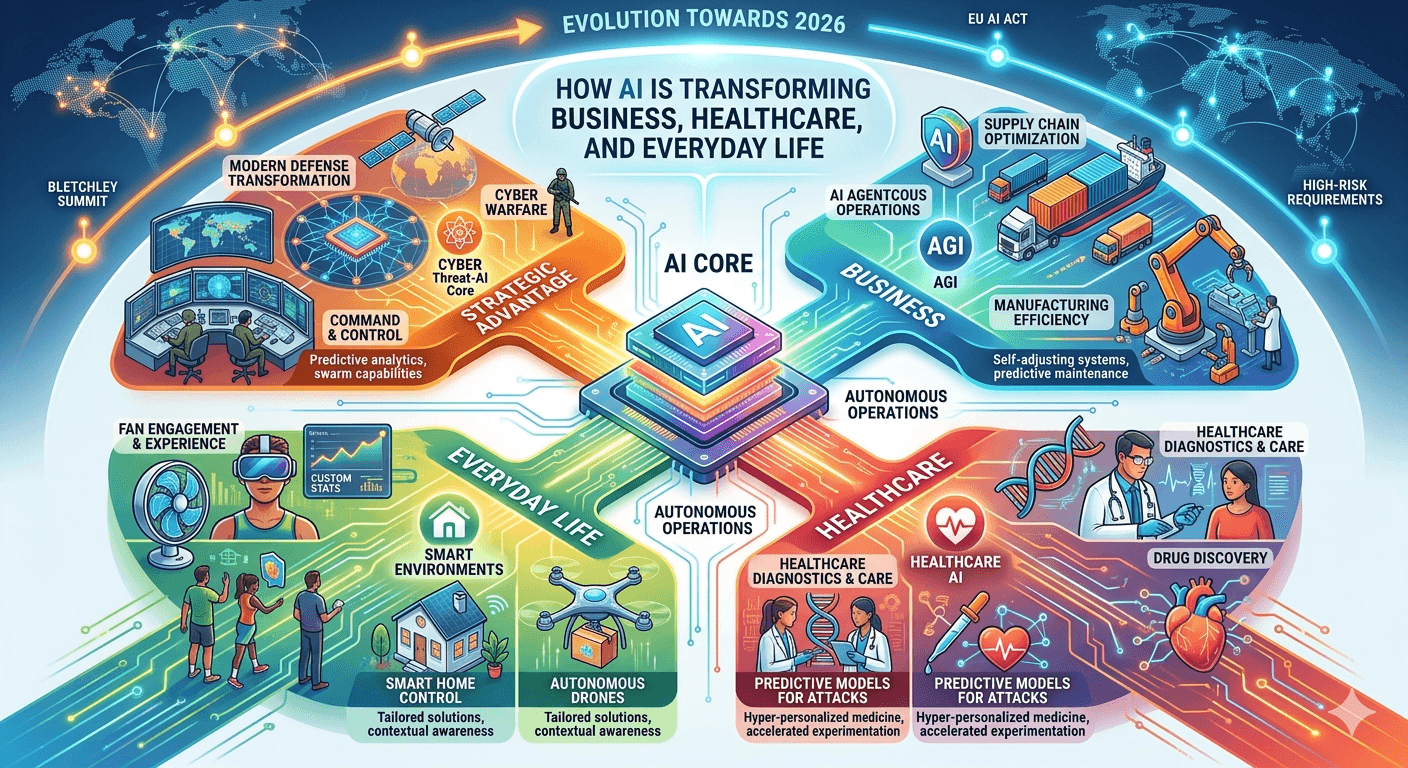
How AI Is Transforming Business, Healthcare, and Everyday Life
Artificial intelligence is rapidly transforming the way the world works, reshaping business, healthcare, and everyday life in ways that were unimaginable just a few years ago. In 2026, AI is no longer a future concept — it is an active force driving efficiency, personalization, and innovation across nearly every industry.
In the business world, AI has become a powerful tool for decision-making and automation. Companies now use AI systems to analyze customer behavior, predict market trends, and optimize operations in real time. Marketing teams rely on AI to create personalized advertising campaigns, while sales departments use predictive analytics to identify potential customers more accurately. Automation powered by AI is also streamlining administrative tasks such as scheduling, data entry, and customer support. This allows businesses to reduce costs, improve productivity, and focus more on strategic growth. Large corporations and small startups alike are using AI to gain a competitive advantage in an increasingly digital economy.
Healthcare is another sector experiencing a major transformation due to artificial intelligence. AI-powered diagnostic tools can now detect diseases such as cancer, heart conditions, and neurological disorders at earlier stages with greater accuracy. Medical imaging systems use AI to analyze X-rays, MRIs, and CT scans, helping doctors make faster and more precise decisions. In addition, AI is being used to develop personalized treatment plans based on a patient’s genetic data, medical history, and lifestyle. Virtual health assistants and chatbots are also improving patient care by providing 24/7 support and answering basic medical questions. In research, AI accelerates drug discovery by analyzing millions of chemical compounds, significantly reducing the time needed to develop new treatments.
Beyond business and healthcare, artificial intelligence is also transforming everyday life. Smart assistants like voice-activated AI systems help users manage daily tasks, control smart home devices, and access information instantly. Navigation apps use AI to predict traffic patterns and suggest faster routes, while streaming platforms rely on AI algorithms to recommend movies, music, and content tailored to individual preferences. Even online shopping has become more personalized, with AI systems suggesting products based on user behavior and preferences.
Education is also evolving with AI-powered learning platforms that adapt to each student’s needs, offering personalized lessons and feedback. In transportation, autonomous vehicles and AI-assisted driving systems are making travel safer and more efficient. Meanwhile, social media platforms use AI to filter content, detect harmful material, and enhance user engagement.
Despite its many benefits, the rise of AI also brings challenges such as job displacement, data privacy concerns, and ethical questions about automation and decision-making. However, most experts agree that artificial intelligence will continue to play an increasingly important role in shaping the future.
As AI continues to evolve, it is clear that it is not just transforming individual industries — it is redefining how people live, work, and interact with the world around them.