
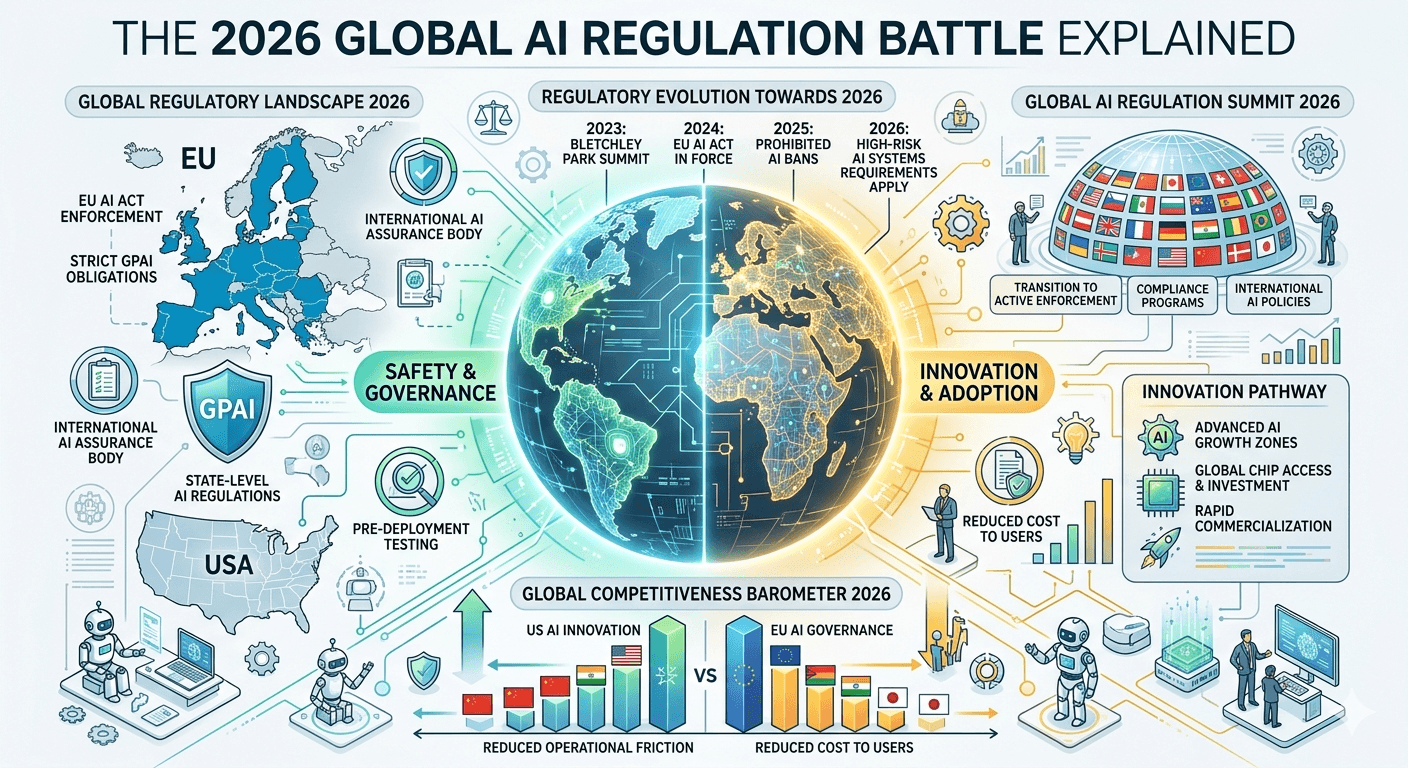
The 2026 Global AI Regulation Battle Explained
The global battle over artificial intelligence regulation is becoming one of the defining technology stories of 2026. Governments, technology companies, researchers, and international organizations are now debating how advanced AI systems should be controlled as artificial intelligence rapidly transforms industries, economies, and everyday life. While some countries push for strict regulations and safety standards, others want fewer restrictions to accelerate innovation and remain competitive in the global AI race.
The rapid growth of AI technology is the main reason this debate has intensified. Modern AI systems can now generate realistic images and videos, create software code, analyze enormous amounts of data, and automate tasks once performed only by humans. Businesses are integrating AI into healthcare, finance, transportation, education, and cybersecurity at unprecedented speed. However, the same technology also raises concerns about misinformation, deepfakes, job displacement, cyberattacks, and privacy risks.
One of the biggest challenges is that countries are taking very different approaches to AI regulation. The European Union continues to support strict rules focused on transparency, ethics, and user protection. European lawmakers argue that advanced AI systems should be heavily monitored to reduce risks and protect citizens from harmful or biased technologies. New regulations require companies to explain how certain AI systems work and ensure that dangerous applications are properly controlled.
In contrast, the United States is attempting to balance regulation with innovation. American technology companies remain global leaders in artificial intelligence, and many business leaders warn that excessive regulation could slow development and weaken the country’s competitive advantage. Instead of broad restrictions, the U.S. government is focusing on safety partnerships with AI companies and creating guidelines for responsible AI development.
China is also aggressively expanding its AI capabilities while increasing government oversight. Chinese authorities view artificial intelligence as both an economic opportunity and a national security priority. The country is investing billions into AI infrastructure, semiconductor development, and smart technologies while implementing strict rules on AI-generated content and online systems.
Another major issue in the 2026 regulation battle is open-source AI. Some experts believe open AI models encourage transparency, innovation, and global collaboration. Others worry that freely available advanced AI systems could be misused for cybercrime, disinformation campaigns, or harmful automated activities. This has created intense debates between technology companies, researchers, and policymakers around the world.
The rise of powerful AI models has also increased pressure for international cooperation. Organizations including the United Nations and global technology alliances are discussing worldwide AI standards similar to agreements used for climate change or nuclear technologies. However, achieving global consensus remains difficult because each country has different political goals, economic interests, and views on technological freedom.
The 2026 global AI regulation battle is ultimately about control, responsibility, and the future of innovation. Artificial intelligence is expected to influence nearly every part of society in the coming years, making regulation one of the most important challenges of the modern digital era. The decisions made today could determine how safely and fairly AI develops for future generations.