
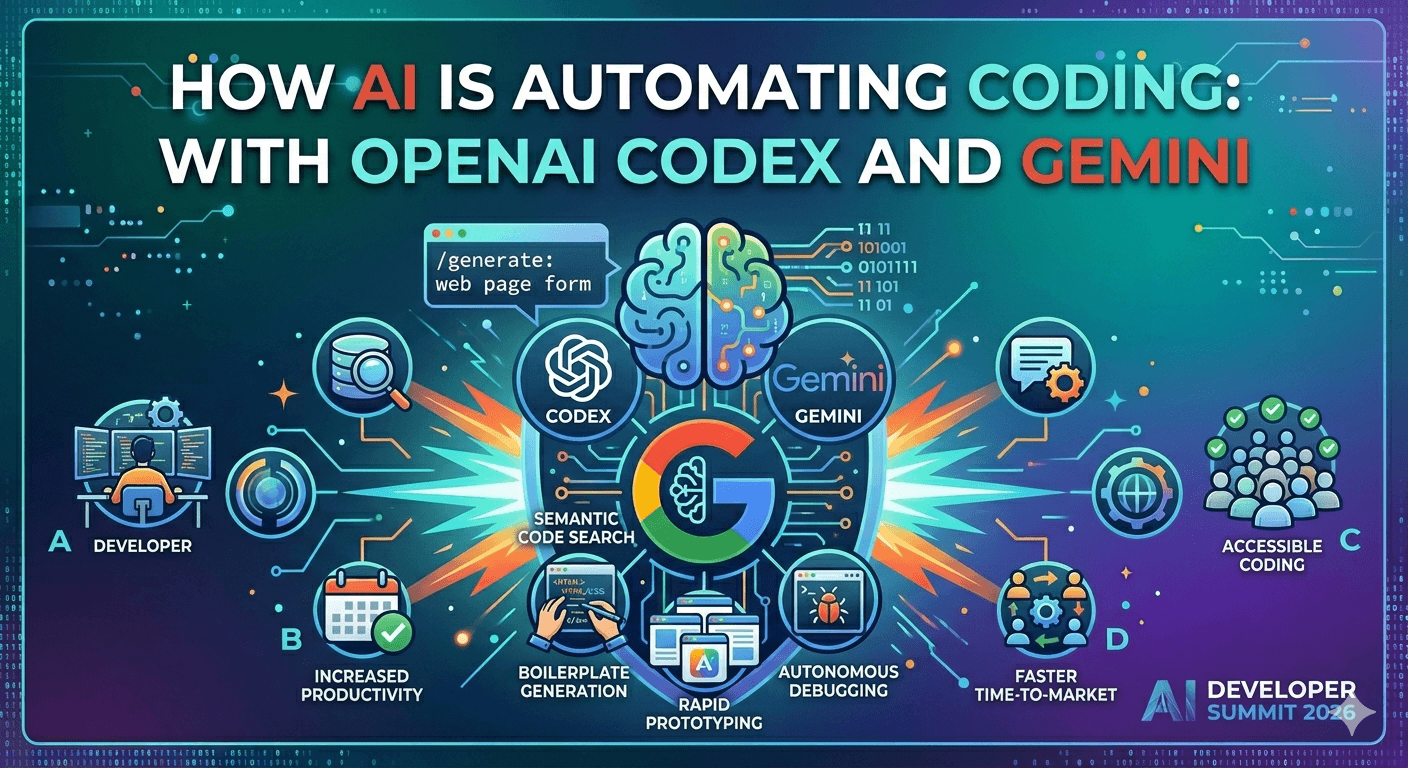
How AI Is Automating Coding with OpenAI Codex and Gemini
The Rise of AI-Powered Software Development
Artificial intelligence is rapidly transforming the world of programming. Tools like OpenAI Codex and Google Gemini are changing how developers write, debug, and manage software projects. What once required hours of manual coding can now be completed in minutes with the help of advanced AI systems.
From generating code automatically to fixing bugs and building full applications, AI coding assistants are becoming an essential part of modern software development.
What Is OpenAI Codex?
OpenAI Codex is an advanced AI coding agent designed to help developers automate programming tasks. According to OpenAI, Codex can write features, answer questions about codebases, fix bugs, run tests, and even suggest pull requests automatically.
Codex operates inside cloud-based sandbox environments and can work on multiple tasks simultaneously. Developers can connect their repositories and allow the AI to analyze files, understand project structures, and generate production-ready code.
One of the most impressive aspects of Codex is its ability to iteratively test and improve its own output until the code works correctly. This reduces repetitive work and helps programmers focus on higher-level problem solving.
Gemini Is Expanding Beyond Search
Google’s Gemini platform is also becoming a powerful AI tool for developers. At Google I/O 2026, the company introduced new “agentic” Gemini capabilities focused on coding, automation, and app development.
Gemini 3.5 Flash is optimized for coding workflows and can assist with writing functions, generating UI components, debugging applications, and automating development tasks. Google is deeply integrating Gemini into Android, Workspace, Search, and cloud services.
The company is also developing AI agents capable of completing tasks across apps, browsing the web, and interacting with developer tools automatically.
How AI Coding Tools Are Changing Programming
AI coding assistants are improving productivity for both beginners and professional developers. Instead of manually writing repetitive code, programmers can now describe what they want in plain language and let AI generate large portions of the application.
These tools are especially useful for:
- Writing boilerplate code
- Debugging errors
- Creating APIs and databases
- Building websites and mobile apps
- Generating documentation
- Automating testing workflows
AI is also making software development more accessible to non-programmers. Many modern AI platforms allow users to create apps simply by describing their ideas in natural language.
Challenges and Limitations
Despite their advantages, AI coding tools still have limitations. Researchers studying tools like Codex and Gemini found that integration issues, API errors, and execution failures remain common challenges.
Developers still need to review AI-generated code carefully to ensure security, accuracy, and performance. AI can accelerate development, but human oversight remains essential.
The Future of AI Programming
The future of software development is becoming increasingly automated. Companies like OpenAI and Google are building AI systems that can act more like autonomous engineering assistants rather than simple chatbots.
As AI models continue to improve, coding may become faster, more collaborative, and more accessible than ever before. Tools like Codex and Gemini are not replacing developers — they are transforming how developers work in the AI era.