
AI Safety vs Innovation: Who Should Control Advanced AI?
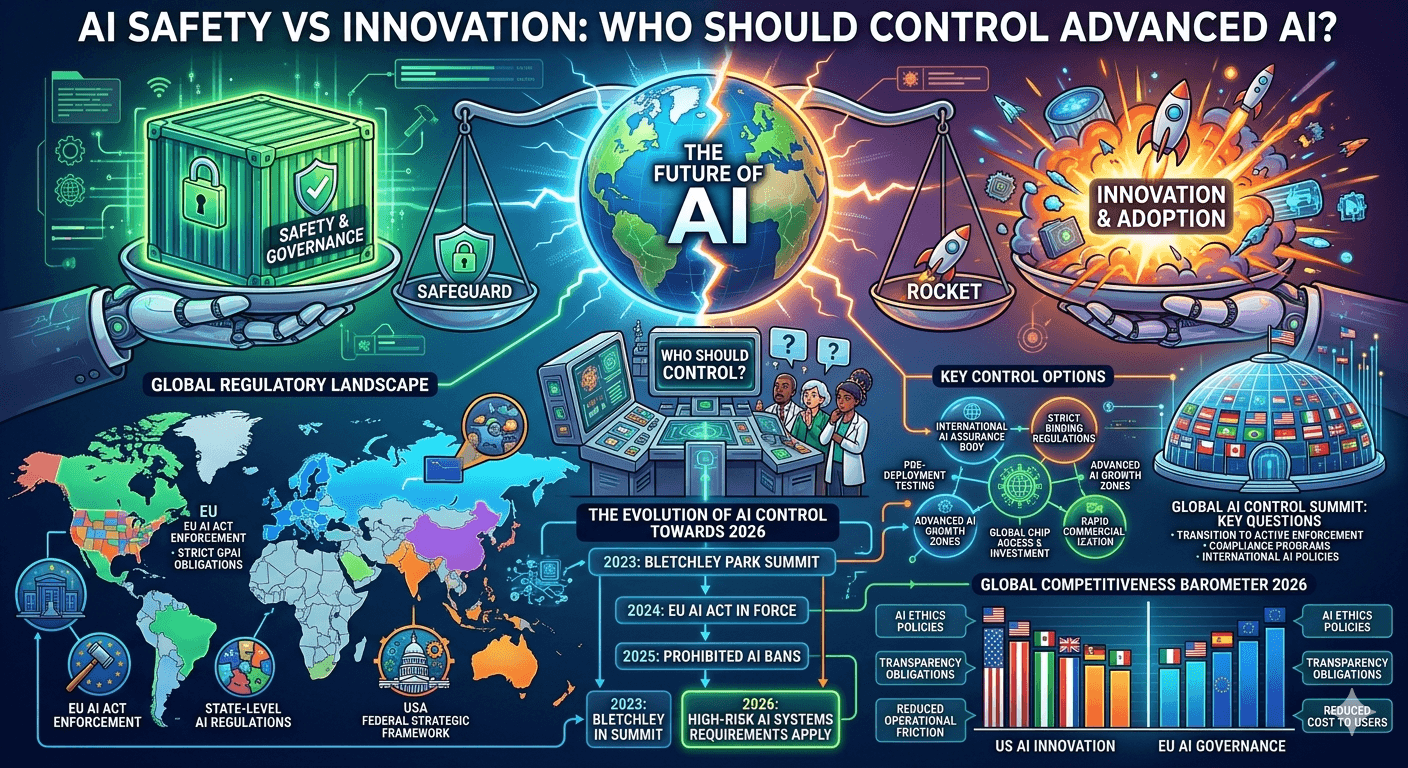
Artificial intelligence is developing faster than ever before, creating both excitement and concern around the world. Advanced AI systems are now capable of generating realistic content, writing code, analyzing massive amounts of information, and even making complex decisions. While these innovations could transform industries and improve everyday life, they also raise important questions about safety, regulation, and control. The growing debate between AI safety and innovation has become one of the most important technology discussions of 2026.
Supporters of rapid AI innovation believe advanced artificial intelligence could solve major global challenges. AI is already helping doctors detect diseases earlier, improving scientific research, automating business processes, and making technology more accessible. Companies developing powerful AI systems argue that slowing progress could reduce economic growth and allow competing nations to take the lead in one of the world’s most valuable technologies. Many experts compare the AI race to previous technological revolutions such as the internet or electricity, where innovation created enormous benefits for society.
However, critics warn that advanced AI could also create serious risks if development moves too quickly without proper oversight. Concerns include misinformation, cyberattacks, deepfake content, job displacement, and autonomous systems making harmful decisions. Some researchers fear future AI models could become so powerful that humans may struggle to fully understand or control them. As a result, governments and technology leaders are debating how artificial intelligence should be regulated before these risks grow larger.
One of the biggest questions is who should control advanced AI systems. Large technology companies currently dominate AI development because they have access to massive computing resources, data centers, and specialized AI chips. Critics argue that allowing only a few corporations to control powerful AI models could create dangerous monopolies and limit transparency. Others believe governments should play a larger role by introducing international regulations, safety standards, and independent oversight organizations.
At the same time, too much regulation could slow innovation and prevent smaller companies from competing. Many startups worry that strict rules may only benefit giant corporations that can afford expensive compliance systems. Developers also argue that open-source AI research encourages transparency and faster scientific progress. This creates a difficult balance between protecting society and allowing innovation to continue.
Another important issue is global competition. Countries including the United States, China, and members of the European Union are investing billions into artificial intelligence development. Governments fear falling behind in the AI race because advanced AI could influence future economic power, cybersecurity, and military capabilities. This international competition makes regulation even more complicated, as different nations may adopt completely different approaches to AI control.
The debate between AI safety and innovation will likely shape the future of technology for decades to come. Artificial intelligence has the potential to become one of humanity’s greatest tools, but it also requires responsible development and careful oversight. Finding the right balance between innovation, regulation, and public safety may become one of the defining challenges of the modern digital era.